
Vegetable rates may ease from September, led by tomato prices, which have started showing signs of correction on the back of increased supply, Reserve Bank of India (RBI) Governor Shaktikanta Das said on Wednesday. "Looking ahead, the spike in vegetable prices in July is starting to see a correction, led by tomato prices. "New arrivals of tomatoes in mandis are already softening the prices, coupled with proactive supply management in the case of onions.

'Data-dependence means you can raise or drop rates. The present stance is only for raising rates.'

Surplus liquidity in the banking system as measured by absorption of excess funds by the Reserve Bank of India (RBI) fell sharply at the end of the last week due to outflows on account of advance tax payments. According to the RBI data, the net liquidity absorbed by the central bank on September 16 was at Rs 3,243.57 crore, much lower than the average of Rs 56,809.92 crore in the preceding four days of the week. The average absorption of funds by the RBI so far in September is at Rs 1.13 trillion, against the average of Rs 1.2 trillion in the previous month, the data showed.

The Reserve Bank of India's rate-setting panel will go for a 0.35 per cent hike in the key repo rate at its meeting next week, an American brokerage said on Wednesday. The hike will be accompanied by a change in the policy stance to "calibrated tightening", Bofa Securities said in a report published ahead of the Monetary Policy Committee (MPC) resolution which is set to be announced on August 5. RBI has hiked the rate by a cumulative 0.90 per cent in two tightening moves in May and June, responding to the runaway headline inflation which has consistently overshot the upper end of the target set for the central bank for many months.
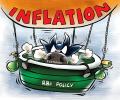
The Reserve Bank on Friday retained its inflation projection for current fiscal year at 6.7 per cent amid global geopolitical developments triggered by Russia-Ukraine war. RBI Governor Shaktikanta Das said the impact of inflation globally is weighing heavily on the domestic market. For September quarter of 2022-23, RBI projected retail inflation at 7.1 per cent.

Describing the recent two consecutive spikes in retail inflation beyond the 6 per cent as a 'transitory hump', a Wall Street brokerage on Monday said it expects the RBI to overlook it and unanimously stick to the dovish stance at the forthcoming policy review, even though a further upward revision of its already-revised inflation target is more likely. The Reserve Bank-led monetary policy panel is scheduled to announce the third monetary policy review on August 6, amidst the continuing spike in retail inflation that has breached the 6 per cent upper tolerance level for the past two consecutive months.
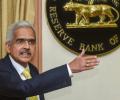
The Reserve Bank of India on Wednesday kept the benchmark interest rate unchanged at 4 per cent and decided to continue with its accommodative stance against the backdrop of concerns over the emergence of the new coronavirus variant Omicron.
The Reserve Bank is expected to go for another rate hike of 0.40 per cent at the scheduled review of the monetary policy next week, a foreign brokerage said on Friday. The central bank's rate setting panel will follow it up with a 0.35 per cent hike in rates at the next review in August, or make it into a 0.50 per cent hike next week and a 0.25 per cent increase in August, to make the total quantum of rate hikes at 0.75 per cent, the report by Bofa Securities said. On May 4, the Reserve Bank of India (RBI) hiked rates by 0.40 per cent, and Governor Shaktikanta Das has already called a rate hike at the forthcoming review as a "no brainer" given the pressure to maintain its core mandate of inflation in the targeted band of under 6 per cent.

Look at the sanctioned plan to know the exact carpet area you will get and pay a law firm to conduct a thorough title check.

The Reserve Bank of India on Friday decided to keep benchmark interest rate unchanged at 4 per cent but maintained an accommodative stance even as the economy is showing signs of recovery after the second Covid wave.

Mortgage lender HDFC Ltd on Wednesday announced an increase in its benchmark lending rate by 5 basis points (bps), a move that will make loans dearer for both existing and new borrowers. This is the third hike effected by HDFC in the last one month. "HDFC increases its Retail Prime Lending Rate (RPLR) on housing loans, on which its Adjustable Rate Home Loans (ARHL) are benchmarked, by 5 basis points, with effect from June 1, 2022," the housing finance company said in a statement.

India's services sector growth eased to a three-month low in June but service providers continued to signal positive demand trends, which resulted in a stronger increase in new business volumes and further job creation, a monthly survey said on Wednesday. The seasonally adjusted S&P Global India Services PMI Business Activity Index fell from 61.2 in May to 58.5 in June. Despite falling from May, the latest figure was consistent with a sharp pace of growth.

The spike in food prices at the onset of the monsoon season has corroborated the Reserve Bank of India's (RBI's) view that the fight against inflation is far from over, the State of the Economy report of the central bank said. At the same time, the report said that the country is poised to become the fastest-growing major economy in the world, notwithstanding some sequential moderation in economic activity in June. Consumer Price Index (CPI)-based inflation rate increased to 4.8 per cent in June 2023, from 4.3 per cent in May, primarily on account of an increase in food inflation.

After two years of a record low interest-rate regime, Indian corporate houses are experiencing a sharp and abrupt increase in funding costs. With the Reserve Bank of India last month making an unequivocal turn towards policy tightening amid high inflation, firms looking to tap the capital markets for funds are ending up shelling out more. The yield on the benchmark triple-A-rated corporate bonds maturing in three years has climbed 98 basis points (bps) since the policy rate hike in May. It was last at 7.47 per cent, Bloomberg data showed.

Innovation ranging from exterior designs of vehicles to EV charger locks grabbed eyeballs at the expo

Citing the sharp rise in food prices, economists at a foreign bank have forecast a steeply higher retail inflation print for July, pegging it at 6.7 per cent, up 190 basis points from the previous month. Deutsche Bank India economists led by chief economist Kaushik Das, in a report on Monday ahead of the monthly inflation print and the Reserve Bank's monetary policy review, said that the July consumer price-based inflation index (CPI) is likely to print at 6.7 per cent on-year as against 4.8 per cent in June. The Reserve Bank is widely believed to leave the key interest rates unchanged for the fourth time in its upcoming bi-monthly monetary policy decision on August 10.

'Banks are being encouraged to lend instead of parking their resources with the RBI and earn risk-free interest income,' points out Tamal Bandyopadhyay.

For all its claims to economic glory, the majority of India's population lives vulnerable lives, a situation that has only worsened over the past 15 years, to the extent that the government now fears to release economic data or even conduct a proper Census, notes Rathin Roy.

Probably 35 bps. There could be even an encore in February 2023 to take the policy rate to 6.5% before the financial year ends, predicts Tamal Bandyopadhyay.

The S&P BSE Realty Index has emerged as one of the top-performing sectors, yielding a remarkable 45 per cent return over the past six months. The three leading players, listed by market capitalisation, have substantially enriched investor wealth by 43-70 per cent during this period. If the second quarter (Q2) of 2023-24 (FY24) updates from Macrotech Developers (Lodha) and Sobha, along with industry data for the quarter, serve as any indication, the trend of strong bookings for larger players is expected to continue.
Reserve Bank of India (RBI) on Friday kept the benchmark interest rate unchanged at 4 per cent and decided to continue with its accommodative stance despite rising inflation. This is the 11th time in a row that the Monetary Policy Committee (MPC) headed by RBI Governor Shaktikanta Das has maintained the status quo. RBI had last revised its policy repo rate or the short-term lending rate on May 22, 2020 in an off-policy cycle to perk up demand by cutting the interest rate to a historic low.

Monetary Policy Committee keeps key interest rate (repo) unchanged at 4% for 7th consecutive time; Consequently, reverse repo rate too remains unchanged at 3.35%; Bank rate also remains same at 4.25%;

The Reserve Bank's rate-setting panel began its three-day deliberations on Monday to decide the next monetary policy amid expectations that the central bank will maintain status quo on the benchmark interest rate in the backdrop of global scare due to the new coronavirus variant Omicron. Reserve Bank Governor Shaktikanta Das headed six-member Monetary Policy Committee (MPC) is scheduled to announce the policy resolution on Wednesday. If the RBI maintains status quo in policy rates on Wednesday, it would be the ninth consecutive time since the rate remains unchanged.

The real estate market has seen a decline in affordability due to the recent rise in median loan rates as a result of the 50 basis points (bps) hike in repo rates by the Reserve Bank of India (RBI). A cumulative increase of 0.95 per cent in median home loan rate has impacted the purchase affordability and purchase decisions of homebuyers, according to the Affordability Index by Knight Frank. The Affordability Index tracks the EMI (equated-monthly instalment) to income ratio for an average household.

Bond markets, global as well as domestic, are likely headed towards hard times over the next three to six months, as higher vegetable prices, rising fuel costs, and improved wages may keep inflation hot, believe analysts, who expect the yields to hit 7.5 per cent in the near-term from the current 7.234 per cent. In this backdrop, they suggest investors can put in money in funds/instruments with residual maturity of 4 to 6 years, while longer-term investors can allocate cautiously to the longer end in the range beyond 7 years.

'Nobody is talking about the inequality that is going to come.'

The Reserve Bank of India on Thursday decided to keep policy rate unchanged for third time in a row as it maintains heightened vigil on inflation. The rate increase cycle was paused in April after six consecutive rate hikes aggregating to 250 basis points since May 2022.

"We will raise Rs 300 crore via bonds of two-, three- and five-year tenures. This will be our maiden bond issuance and is part of our effort to widen funding sources," says Vimal Bhandari, executive vice-chairman and chief executive officer (CEO), Arka Fincap. The firm, a subsidiary of Kirloskar Oil, is only five years old and small (assets of around Rs 5,000 crore with an "AA" rating), but the response to this float will be closely watched: It would be the first by a non-banking finance company (NBFC) after Mint Road upped the risk weights on bank exposures to them by 25 percentage points. The move by the Reserve Bank of India (RBI) has caught NBFCs off guard even though the issue had been flagged by Governor Shaktikanta Das with their corner-room occupants (and that of banks) in July and August 2023 - on consumer credit and the dependency on bank borrowings.

Retail inflation breached the RBI's comfort zone and rose to a three-month high of 6.52 per cent in January, mainly on account of a spike in food prices, as per government data released on Monday. The inflation rate based on the Consumer Price Index (CPI) stood at 5.72 per cent December and 6.01 per cent in January 2022.

The country's largest lender State Bank of India has raised its marginal cost of funds based lending rate by 10 basis points or 0.1 per cent across all tenures, a move that will lead to an increase in EMIs for borrowers. This is the second hike in a month raising the cost by 0.2 per cent with the two consecutive increases. The revision follows an off-cycle rate increase by the Reserve Bank earlier this month. The central bank hiked the repo rate -- at which it lends short term money to banks -- by 0.40 per cent to 4.40 per cent.

'Even if there is a third wave or a fourth wave, it is hard to see the economy will suffer like that (during the first wave).'

India's prices are rising faster than many of its emerging market peers. The country's inflation print for May at 4.25 per cent is a marked reduction from the levels seen in May 2022 (7.04 per cent). However, even though the inflation rate remains within the Reserve Bank of India's medium-term target of 4 per cent, with a 2 per cent margin on either side, it continues to be higher than China, Russia, and Brazil.

Tata Steel was the top gainer in the Sensex pack, climbing 2.11 per cent, followed by Infosys, HDFC Bank, HDFC, Kotak Bank, M&M and PowerGrid. NSE Nifty jumped 142.05 points to end at 17,605.85.

The share of low-cost money in total deposits continued to take a knock at the close of FY23 as banks engaged in intense competition by offering higher interest rates on term money to garner funds amid tight liquidity conditions. The share of current accounts and saving accounts (CASA) in total deposits declined by 2-4 per cent by end of March 2023 from March 2022 figure, according to BSE filings by private banks. The ease of movement of funds on digital platforms and the deployment of money by businesses from current accounts also played a role in dwindling the share of CASA money.

Shifting to floating rate deposits can work as an anaesthetic gel for some customers, points out Tamal Bandyopadhyay.

Mortgage lender HDFC Ltd on Friday hiked its lending rate by 50 basis points hours after the Reserve Bank raised the benchmark interest rate to tame inflation. The move would increase EMIs for housing loans by the firm. "HDFC increases its Retail Prime Lending Rate (RPLR) on Housing loans, on which its Adjustable Rate Home Loans (ARHL) are benchmarked, by 50 basis points, with effect from October 1, 2022," the country's biggest housing finance company said in a statement.
RBI will be cautious easing rates further given oil price uncertainties

The government on Friday raised interest rates on most post office saving schemes by up to 0.7 per cent for the April-June 2023 quarter in line with the firming of interest rates in the economy. While the interest rates for popular PPF and savings deposits have been retained at 7.1 per cent and 4 per cent, respectively, there has been an increase between 0.1 per cent and 0.7 per cent in other saving schemes, a finance ministry statement said. The highest increase was in the interest rate of the National Savings Certificate (NSC), which will now attract 7.7 per cent, up from 7 per cent, for the April 1 to June 30, 2023 period.
The Reserve Bank on Wednesday increased the benchmark lending rate by 40 basis points (bps) to 4.40 per cent in a bid to contain inflation, which has remained stubbornly above the target zone of 6 per cent for the last three months. The decision follows an unscheduled meeting of the Monetary Policy Committee (MPC), with all six members unanimously voting for a rate hike while maintaining the accommodative stance. While the inflation has remained above the targetted 6 per cent since January, RBI Governor Shaktikanta Das said the inflation print in April is also likely to be high.

India is expected to contribute 15 per cent to the global growth in 2023, an International Monetary Fund (IMF) official said on Tuesday. "Both India and China are expected to contribute 50 per cent of the global growth in the upcoming year (2023). "However, the share of India's contribution to global growth is expected to be around 15 per cent," Krishna Srinivasan, director, Asia and Pacific Department (APD) at IMF said at a roundtable with reporters from south Asian countries.
